
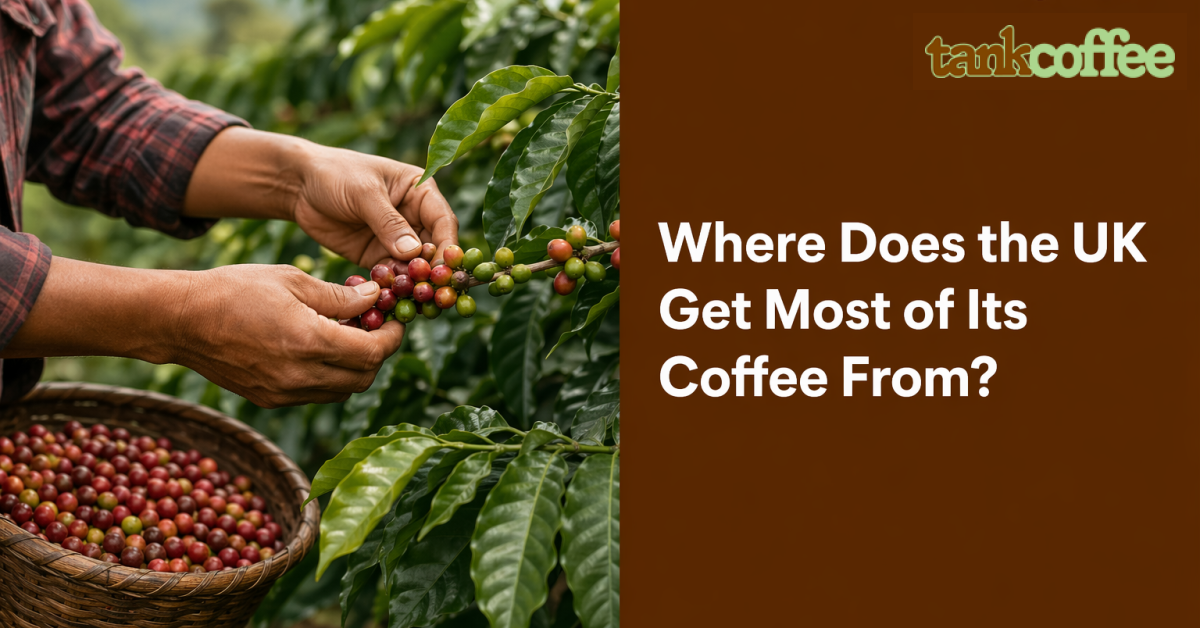
Where Does the UK Get Most of Its Coffee From?
The UK sources most of its coffee from a concentrated group of producing countries. Brazil and Vietnam carry the largest share, followed by Colombia, Honduras, Peru and a rotating supporting cast that includes Ethiopia, Guatemala and Uganda.
Green beans dominate those flows, because UK roasters prefer to control roasting, blending and packing domestically rather than import finished product. The pattern is driven by commercial logic more than taste preference. Species demand, shipment scale, price cover, freight stability and buyer compliance rules all shape which origins show up on a roaster’s contract sheet in any given year.
Key Takeaways
Here is a quick summary of how UK coffee sourcing actually works.
- Brazil and Vietnam supply the majority of UK coffee imports by volume, with Brazil dominating arabica and Vietnam dominating robusta.
- The overwhelming majority of imports arrive as green coffee, giving UK roasters control of roast profile and freshness.
- Colombia, Honduras and Peru fill the washed arabica middle ground, often with Fairtrade, organic or Rainforest Alliance certification.
- Ethiopia, Kenya, Guatemala, Uganda and Rwanda supply smaller, specialty-focused volumes.
- Weather, freight, sterling strength and regulation drive year-on-year shifts more than taste trends.
- Roasters typically blend importer purchases with a smaller share of direct or relationship coffees.
Together, these forces shape the blend sheet long before any coffee reaches a cup.
UK Coffee Sourcing At a Glance
This table summarises the main origins, their role in the UK market, and the typical end use.
| Origin | Species Role | Typical End Use |
|---|---|---|
| Brazil | Arabica and conilon, scale base | Espresso bases, supermarket blends, private label |
| Vietnam | Robusta backbone | Instant coffee, commercial blend filler |
| Colombia | Washed arabica | Supermarket ranges, café menus, single origin |
| Honduras and Peru | Certified washed arabica | Supermarket tenders, blend component |
| Ethiopia | Washed and natural arabica | Specialty retail, single origin |
| Kenya, Rwanda, Guatemala, Uganda | Specialty and supporting volumes | Subscription, premium retail |
These roles are commercial slots, not rankings, and each origin earns its share for a specific reason.
How UK Coffee Imports Actually Break Down
Most coffee entering the UK arrives unroasted. Green coffee gives roasters control over freshness windows, blend composition, grade selection and stock rotation, and it keeps more of the value-added work onshore.
Roasted and soluble imports exist, but they sit in narrower categories such as instant, decaf and certain branded lines where the exporter roasts at origin or in a nearby European hub.
Green Coffee Versus Roasted And Soluble
Green coffee lands in jute, GrainPro-lined or vacuum packs, usually in 60kg or 69kg bags depending on origin convention, and moves through bonded warehousing before release to roasters.
Roasted imports carry a shorter shelf life on arrival and offer little flexibility in profile adjustment. Soluble and freeze-dried products are a separate trade, often tied to robusta-heavy manufacturing hubs.
Why The Import Mix Shapes Pricing
A supply chain built on green coffee keeps roasting capacity, labour and margin in the UK. It also means landed cost tracks green differentials, freight rates and sterling strength rather than finished-goods inflation alone.
When shipping costs spike or sterling weakens, roasters feel it through cost of goods before it reaches the shelf.
The Countries That Supply Most Of The UK’s Coffee
Brazil and Vietnam together account for a disproportionate share of UK inbound volume, and that concentration has held steady for years. Colombia and several Central and South American origins fill the middle ground, while specialty demand pulls smaller volumes from East Africa and parts of Central America.
Brazil
Brazil does the heavy lifting for commercial espresso bases, supermarket blends and private label programmes. Natural and pulped natural processing, large farm infrastructure and consistent export logistics mean Brazilian arabica, along with conilon, can be contracted at the volumes a national roaster needs.
A roaster building a house espresso for café accounts usually starts with a Brazilian base and adjusts from there.
Vietnam
Vietnam is the robusta backbone. The UK instant coffee segment leans heavily on Vietnamese robusta for body, caffeine load and price discipline, and many commercial blends use small robusta percentages to build crema and reduce raw material cost.
Specialty channels rarely touch this supply, but it underwrites a significant slice of everyday UK coffee consumption.
Colombia
Colombian washed arabica occupies the ground between commodity blend filler and single-origin retail. It travels well through supermarket ranges, coffee shop menus and branded gift packs because the flavour profile, typically balanced with mild fruit and clean acidity, is easy for a broad audience to accept.
Honduras, Peru And The Wider Field
Honduras and Peru contribute meaningful volume, often with Fairtrade, organic or Rainforest Alliance certification attached, which matters for supermarket tenders.
Ethiopia adds the cup character that specialty roasters and origin-led retail want, whether that’s a washed Yirgacheffe with jasmine and citrus notes or a natural Sidamo carrying heavier berry and wine tones. Guatemala, Uganda, Kenya and Rwanda round out the list in smaller but commercially useful quantities.
Why Supplier Rankings Move Year To Year
Ranking changes are usually not dramatic. A frost in Minas Gerais, a drought in the Central Highlands of Vietnam or a currency shock can shift volumes across a season, but origins tend to substitute within similar flavour and species categories rather than disappear.
A buyer losing Brazilian arabica cover is more likely to rebalance toward Honduras or Peru than pivot to East Africa.
How Coffee Physically Reaches The UK
Almost all green coffee arrives by sea. Containers move from origin ports such as Santos, Ho Chi Minh City, Buenaventura, Puerto Cortés and Djibouti, either direct to UK ports or transhipped through continental European hubs including Antwerp, Hamburg and Le Havre.
From there, coffee clears customs, enters bonded or commercial storage and moves to roasting sites by road.
The Friction Points Roasters Actually Notice
The Atlantic or Asian crossing is rarely the problem. Delays show up closer to home: container availability at origin, port congestion, customs paperwork under post-Brexit rules, and inland haulage costs that have been anything but predictable since 2021.
For a roaster in the North West, pulling containers from Felixstowe or Tilbury adds meaningful cost per kilo compared with collection from Liverpool or Manchester.
Traders, Importers And Direct Relationships
Most UK roasters do not buy directly from farms. They work through importers and traders who carry origin stock, manage quality control, hold positions against the futures market and spread shipment timing.
Smaller specialty roasters, including regional operators across Greater Manchester and the North West, often combine importer purchases with a handful of coffees sourced through direct relationships with growers, where the story and traceability justify the extra admin.
Why These Particular Origins Dominate
Each major supplier fills a specific commercial slot that is hard for another origin to replicate at short notice. Much of that pattern is rooted in how coffee trade routes developed over the past two centuries, which set the commercial infrastructure still in use today.
- Brazil provides scale and price stability.
- Vietnam provides robusta at a cost nothing else matches.
- Colombia, Honduras and Peru provide washed arabica with broad acceptance and certification availability.
- East African origins provide cup character that retail and specialty buyers pay a premium for.
These roles rest on climate, certification infrastructure and contract depth, each of which deserves a closer look.
Climate, Elevation And Species Fit
Arabica needs altitude, cooler nights and consistent rainfall, which is why it concentrates in the Latin American highlands and parts of East Africa. Robusta tolerates lower elevations and hotter conditions, which suits Vietnam, parts of Uganda and Indonesia.
Those climatic facts explain most of the map before any commercial decision enters the picture.
Certification And Due Diligence
Supermarket ranges, larger branded roasters and public sector foodservice contracts often require Fairtrade and Rainforest Alliance standards, organic certification or EU Deforestation Regulation compliance.
Origins with established certification infrastructure, Honduras and Peru being clear examples, win tenders that less organised supply chains cannot service, regardless of cup quality.
Contract Depth And Shipment Reliability
A single microlot from a small washing station might cup beautifully but cannot cover a 40-tonne annual contract. Buyers needing predictable weekly roasting volumes stay with origins that can deliver against forward contracts without surprises.
Arabica, Robusta And The Processed Categories
Arabica carries the larger share of UK imports by value and dominates roast and ground, wholebean and specialty channels. Robusta carries a smaller share by value but a significant share by weight, most of it flowing into instant and blended applications.
Where Arabica Goes
Arabica supplies almost all branded retail coffee, coffee shop espresso menus, subscription boxes and specialty single origins. Flavour range, acidity and origin-led storytelling all depend on arabica, and the price premium over robusta reflects that.
Where Robusta Earns Its Place
Robusta underpins the instant segment, appears in commercial espresso blends for crema and body, and controls cost in value-tier products. It is not a lesser coffee so much as a different tool.
A 10 to 15 percent robusta addition in a traditional Italian-style espresso blend is a legitimate profile choice, not a cost dodge.
Decaf And Soluble Imports
Decaffeinated coffee enters as green decaf for UK roasting, pre-roasted decaf, or finished soluble. Swiss Water, CO2 and sugarcane EA processes each affect cup quality and price differently.
Decaf volumes are smaller but the category is growing steadily, particularly in office supply and subscription formats.
What The Trade Data Does And Doesn’t Tell You
Customs data shows declared weight, value and product form by country of origin. It is useful for identifying structural dependence, but the limits are clear.
| Trade Data View | What It Reveals | What It Misses |
|---|---|---|
| Volume by origin | Physical supply dependence | Quality tier or end use |
| Value by origin | Premium exposure and spend mix | Doesn’t track cup score |
| Product form | Green, roasted or soluble split | Final roast destination |
| Year-on-year change | Substitution and supply shifts | Short spikes can mislead |
A high-value, low-volume entry from Ethiopia tells you specialty buyers are paying up for microlots. A high-volume, lower-value entry from Vietnam tells you robusta is flowing into instant manufacturing. Neither number tells you whether a specific blend changed composition.
How Consumer Demand Pulls The Map
Supermarkets reward consistency, which keeps major origins central. Coffee shop growth across the UK has widened interest in named origins, seasonal lots and process experimentation, which quietly enlarges the supporting cast of suppliers.
Subscription services and direct-to-consumer roasters have broadened demand for Ethiopian, Kenyan, Rwandan and Honduran coffees that would have been rare on UK shelves twenty years ago.
The Everyday Blend Segment
Own-label and branded everyday blends live or die on price stability and flavour consistency. Buyers in this segment optimise around Brazil, Vietnam, Honduras and Peru, adjusting grade, screen size and blend percentage rather than swapping origins wholesale.
The Specialty And Office Segment
Office coffee, subscription roasting and specialty retail pull harder on origin diversity. A 250g bag of single-origin Ethiopian Yirgacheffe or a Kenyan AB sits comfortably in a subscription box even when the same customer drinks a commercial blend at work, which is much of the case for single origin in the first place.
Demand has layered rather than replaced.
Risks That Keep Buyers Awake
Weather, freight, currency and regulation are the four pressure points that move UK sourcing decisions. None of them remove an origin permanently, but together they shape the blend sheet more than most drinkers realise.
Weather And Harvest
A hard frost in Brazil in 2021 pushed arabica futures to multi-year highs and rippled through UK contracts for eighteen months. Drought in Vietnam feeds straight into robusta pricing and, from there, into instant coffee cost bases.
Excessive rain during harvest in Colombia changes bean density and screen size, which affects roast behaviour.
Freight And Sterling
Container rates between 2020 and 2022 showed how quickly landed cost can detach from green differentials. Sterling weakness against the US dollar, the currency most green coffee trades in, lifts import cost even when origin prices are flat.
Regulation And Traceability
The EU Deforestation Regulation and comparable UK due diligence expectations push documentation requirements further up the supply chain. Origins with functioning exporter traceability systems gain an advantage.
Origins with fragmented smallholder supply and weaker paperwork face access friction, regardless of cup quality.
How UK Roasters Actually Choose
Roaster buying behaviour splits roughly along business model lines. A national volume roaster optimises for repeatability, price cover and contract depth. A regional specialty roaster, including the sort of origin-led operation that has grown across Greater Manchester and the North West such as our roastery in Greater Manchester, optimises for cup quality, freshness and a story the end customer will pay attention to.
Volume Buying Logic
Forward contracts covering six to twelve months, standardised grades, preference for origins with deep export capacity, tight specification on moisture and defect count.
The priority is a blend that tastes the same in March and October.
Specialty Buying Logic
Shorter shipment windows, named farms or cooperatives, seasonal lots, higher cup scores, willingness to absorb price variance in exchange for differentiation.
The priority is a coffee worth writing about on the bag.
Spot Versus Forward
Spot buying gives flexibility for seasonal specials or gap filling. Forward contracts give price cover and planning stability for core blends. Most roasters use both, in different proportions depending on scale.
What The Major Origins Actually Signal
Before anyone cups a sample, origin sets expectations. That shorthand is useful, but it isn’t a guarantee.
- Brazil: nutty, chocolate-led, low-acid, reliable base for espresso and filter blends
- Vietnam: robusta utility, body, cost control, instant and blend use
- Colombia: balanced, washed, mild fruit and clean acidity, broad retail fit
- Honduras and Peru: washed arabica, often certified, flexible blend component
- Ethiopia: floral and fruit-forward washed coffees, berry-heavy naturals, specialty focus
- Kenya: bright acidity, blackcurrant notes, high cup scores, premium pricing
Those East African traits don’t only show up in filter. They carry through to espresso too, which is why an African espresso blend can deliver a fruit-forward, acidic profile that a Brazilian base never will.
Processing method, grade, freshness and blend role frequently outweigh country name once a coffee is in the roaster. A well-processed Honduran lot can outperform a tired Colombian parchment on the cupping table.
The Practical Takeaway For UK Buyers
The UK draws its coffee from a small group of scale producers, led by Brazil and Vietnam, with Colombia and a cluster of Latin American and African origins filling specialised roles. Green imports dominate because UK roasters keep the value-added work at home.
Sourcing decisions follow species demand, shipment scale, certification requirements and landed cost, not simple preference. Responsible roasters set out how we approach sourcing openly, so buyers can see the principles behind a range that balances commodity and specialty origins.
For a buyer choosing a coffee, whether that is a café owner specifying a house espresso, an office manager setting up a subscription, or a home drinker deciding between a blend and a single origin, the useful question isn’t only where the coffee comes from. It’s whether that origin performs reliably for the way the coffee will actually be used.
A Brazilian base coffee and an Ethiopian single origin both have honest places on the shelf, and plenty of UK roasters, including origin-focused operators working out of Greater Manchester, build ranges that respect both.
Frequently Asked Questions
Which country supplies the most coffee to the UK?
Brazil is consistently the largest supplier of coffee to the UK by volume, driven by the scale of its arabica production and the role Brazilian coffee plays in commercial blends and espresso bases. Vietnam sits close behind, mainly through robusta used in instant coffee and value blends. Together they account for a substantial majority of inbound green coffee.
Does the UK import mostly green or roasted coffee?
Green coffee makes up the overwhelming majority of UK imports. Domestic roasters prefer to control roast profile, freshness and blend design, which is easier and more cost-effective when coffee arrives unroasted. Roasted and soluble imports are concentrated in narrower categories such as instant and certain branded lines.
Why does the UK buy so much coffee from Vietnam if specialty coffee usually comes from elsewhere?
Vietnam supplies robusta rather than the washed arabicas that dominate specialty menus. Robusta is essential to the UK instant coffee market and to many commercial espresso blends where body, crema and cost control matter more than origin character. Vietnam’s share reflects industrial use rather than café trends.