
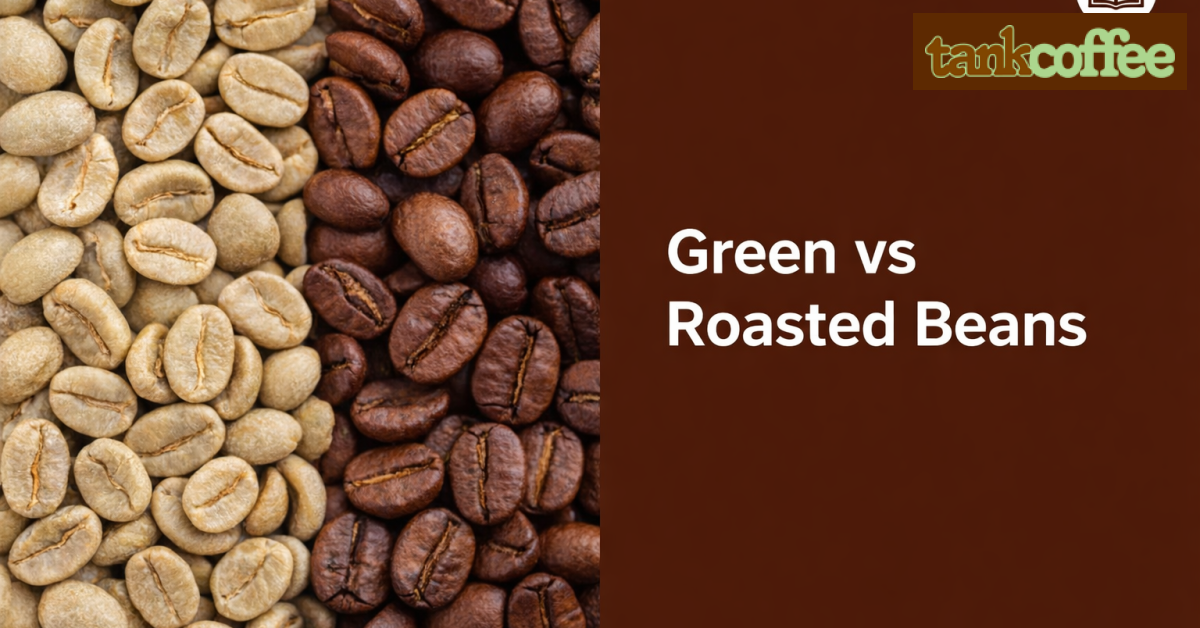
Green vs Roasted Beans
You have a new brewer on the counter, maybe a gift, maybe a long-planned upgrade. Now you face a choice that dictates everything about your first cup: green or roasted beans? One is a raw ingredient requiring a process; the other is a finished product that starts losing its character the moment it leaves our roaster.
To give a real answer, we stopped theorizing and ran the test ourselves. We took a bag of our current washed Ethiopian Sidamo green beans and split it. Half we roasted here in our facility, and the other half we took home to put through the same home-use journey we see our customers attempt, from storing and roasting to grinding and brewing in a typical Manchester kitchen. This isn’t about avoiding mistakes, it’s about making them intelligently.
The Test: Our Ethiopian Sidamo, Two Ways
Green coffee beans are dense, raw seeds; they smell grassy, a bit like dried peas, and have none of the characteristics of coffee. Roasted beans are what happens when heat orchestrates a series of chemical reactions, turning that seed into a brittle, aromatic, and soluble product.
The real difference for a home brewer is control versus convenience. Roasting your own beans, even on a small scale, gives you absolute authority over the final profile. Buying our roasted beans means you trust our expertise to deliver a coffee that’s ready to grind. It’s the difference between wanting to make coffee and wanting to make the coffee ready to brew.
Flavour Profile: What Happens After First Crack
The flavour gap is immense. Raw green Sidamo beans have no brewable coffee flavour. When brewed, they produce a weak, vegetal liquid.
Our Home-Roasted Sidamo: We ran a small batch on a basic air roaster, aiming for a light-to-medium profile. We pushed the heat a bit too fast initially, risking scorching, a common mistake where the bean’s exterior burns before the interior is developed. We pulled back, extending the time to first crack to 8 minutes. The result was a cup with a pronounced, sharp citric acidity and a tea-like body, but the sweet stone fruit notes we get in our shop were less defined.
Our Professionally Roasted Sidamo: The bag we roasted in-house and let degas for 48 hours delivered the profile we expect: bright lemon and peach notes upfront, with a complex floral finish reminiscent of jasmine. The browning reactions were more controlled, developing sweetness that the faster home roast couldn’t quite achieve. Lighter roasts preserve this origin character, while pushing darker mutes the acidity for more roast-driven bitterness.
Shelf Life: The Race Against Oxidation
This is where the trade-off becomes sharp. Green beans, stored in a cool, dark cupboard away from moisture, are stable for 6-12 months. Their quality fades slowly, a gradual loss of vibrancy rather than outright spoilage.
Roasted coffee is a different story. The moment beans leave the roaster, a countdown begins. Volatile aromatic compounds, the source of coffee’s incredible smell and taste, start to escape. Oxygen begins to cause oxidative damage. We ship our beans in bags with one-way valves for a reason. Once opened, that peak flavour window is maybe two weeks. Grinding accelerates this process exponentially by exposing more surface area to oxygen. A bag with a roast date is your only true measure of freshness; a ‘best-before’ date is almost meaningless.
The Home Setup: Equipment, Cost, and Hidden Hurdles
The upfront cost of green beans is lower per kilo. But that number is deceptive.
For Green Beans: You need a home roaster (or a popcorn popper/oven setup for the very adventurous), a way to cool the beans rapidly, and good ventilation unless you enjoy the smell of smoke. You must also account for weight loss, as roasting burns off about 15-20% of the bean’s weight in moisture. Add the cost of a few failed batches, which are inevitable, and the value proposition changes.
For Roasted Beans: Your only essential equipment besides the brewer is a quality burr grinder and an airtight container. We’ve done the labour, absorbed the energy costs, and handled the quality control. You are paying for the removal of work and risk.
The Manchester Factor: Why Our Hard Water Matters
Here in Manchester, our tap water is famously hard. A Reddit user measured their local water at a GH of 350ppm, which is incredibly high. Water this rich in minerals, particularly carbonate hardness (KH), acts as a buffer and neutralizes the bright, pleasant acids that make a coffee like our Sidamo so special. It can leave the coffee tasting flat and uninspired.
This is a powerful argument for home roasting. If you’re already going to the trouble of roasting, you are the kind of person who might also consider controlling your water, whether by using a filter that targets hardness, blending with bottled water like Volvic, or even building your own water from distilled with mineral packets. It’s an extra step, but it unlocks the true profile we work hard to develop.
Our Verdict: Who Are Green Beans Really For?
After our experiment, the conclusion is clear. Roasted beans are the practical, reliable starting point for 99% of home brewers. The path to a great cup is shorter and has fewer variables.
Green beans are for the hobbyist. They are for the person who finds the process of roasting as rewarding as the final drink. They are for the brewer who wants to battle Manchester’s hard water with a custom-roasted, custom-brewed cup. It’s a craft, not a convenience. If that sounds like you, the rewards are immense. If not, let us handle the roast.