
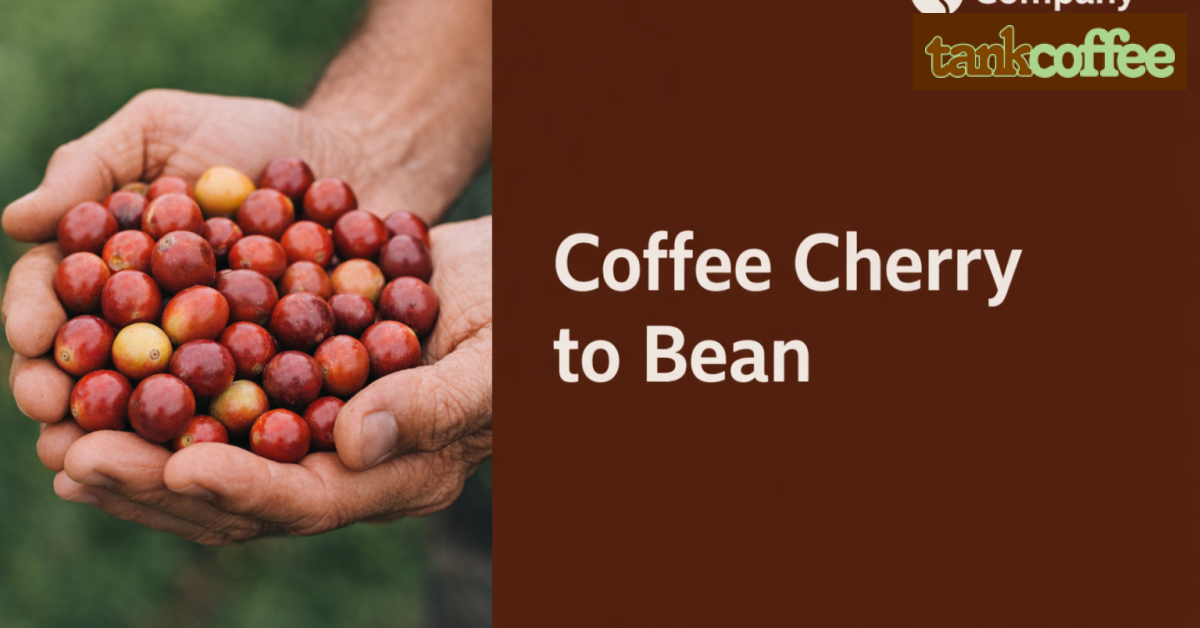
Coffee Cherry to Bean
You are standing in a coffee aisle, looking at two bags. Both promise complex fruit notes, but the price gap is significant. The answer isn’t just about roast level; it often lies in the journey from the branch to the bag.
For our Kenya Kiri Kirinyaga AB, that journey begins on the slopes of Mount Kenya, with smallholder farmers from the Ngiriambu Farmers Cooperative Society.
We follow this specific bean through every stage to understand exactly where its vibrant, wine-like acidity and notes of berries and dried figs come from. This isn’t theoretical. This is how we ensure the coffee you buy is worth its price.
It Starts with the Cherry’s Anatomy
A coffee cherry is a drupe, a fruit with layers protecting the seed that becomes the bean. We obsess over these layers because they dictate drying speed, fermentation, and flavour clarity.
Many people jump straight to the roast profile, but for us, the story of our Kiri AB starts with its fruit structure and the washed process it undergoes at the Kiri Factory.
If you want a quick primer on what coffee beans are, it helps clarify why the cherry’s “seed” is the part we ultimately roast and brew.
Skin, Pulp, Mucilage, and the Prized Parchment
The cherry’s skin is the outer layer. Beneath it lies the pulp, then the intensely sugary, sticky mucilage. The parchment is a crucial protective layer that encases the seed during drying, and the silver skin is the final, tissue-thin layer that clings to the bean itself.
How Each Layer Defines the Final Cup
The mucilage is fermentation fuel; how it’s handled radically changes the sweetness in the final cup. The parchment acts as a buffer, slowing moisture loss during the 20-day drying period on raised beds at the Kiri Factory.
Any inconsistency in removing these fruit layers can introduce muddled or defective flavours, undoing the careful work of the harvest. The cherry’s structure sets the absolute quality ceiling for every step that follows.
The Harvest at Kirinyaga
The quality of a lot is determined the moment the cherries are picked. Mixing ripe and unripe cherries from the SL28 and SL34 trees common in Kirinyaga results in chaotic sugar levels and unpredictable flavours. Better picking costs more in labour, but it’s a non-negotiable trade-off for cup quality.
Selective Picking: The First Quality Decision
The 3,555+ smallholder farmers of the Ngiriambu FCS who deliver to the Kiri Factory practice selective hand-picking. This means multiple passes through the coffee gardens, taking only the perfectly ripe cherries each time. Strip picking, where a whole branch is stripped at once, increases volume but compromises the entire lot with uneven ripeness.
Reading the Ripeness of an SL34 Varietal
For the SL34 varietal, ripeness means a deep, uniform red colour, firm skin, and a high sugar content, which the farmers know by feel and experience. Colour alone isn’t always enough, as some varietals ripen to yellow, but for these classic Kenyan types, a deep red is the key indicator.
The Quality Risks of a Mixed-Ripeness Harvest
Mixed ripeness is where quality first breaks down. Overripe fruit brings a fermented, boozy taste. Underripe fruit is grassy and astringent. Damaged cherries open the door to mould.
The quality baseline established during the harvest on the red volcanic soils of Kirinyaga determines the potential we have to work with back in Manchester.
Processing: Turning a Kenyan Cherry into Green Coffee
Processing is the step that removes the fruit from the seed. It’s the single biggest influence on a coffee’s intrinsic flavour profile. Our Kenya Kiri Kirinyaga AB is a “fully washed” coffee, and that method is directly responsible for its signature clean cup and vibrant acidity.
The Washed Process at Kiri Factory
At the Kiri Factory, the freshly picked cherries are pulped to remove the skin and fruit. They are then fermented in water for 24-36 hours. This fermentation breaks down the sticky mucilage.
Afterwards, the beans are thoroughly washed in clean water and soaked for another 24 hours before being moved to raised beds for drying. This process produces a bright, clean flavour separation.
The Natural Process: A Fruit-Forward Contrast
In contrast, natural processing involves drying the entire cherry first, allowing the fruit’s sugars to deeply infuse the bean. This method, common in other regions, creates intense fruit-bomb flavours and a heavier body but carries a higher risk of wild, uncontrolled fermentation.
Honey Process: The Middle Ground
The honey process removes the skin and pulp but leaves some of the mucilage on the bean while it dries. The result is a coffee that sits between washed and natural, balancing sweetness and clarity. It’s a delicate process that requires precise control over humidity.
Pinpointing Acidity and Sweetness from Processing
The washed method of our Kenyan bean is why its acidity feels so bright and defined. A natural process would have given it a heavier, sweeter, more fruit-dominant character.
Understanding this distinction is key to appreciating why this coffee tastes the way it does, long before it ever meets the heat of our roaster.
The Critical Drying and Milling Stages
Drying brings the green coffee to a stable moisture level for its long journey to our roastery. Milling removes the final protective layers and sorts the beans. Failure here can ruin the impeccable work done during harvesting and processing.
Why a 10.5% Moisture Target is Non-Negotiable
Green coffee must be dried to a stable moisture content, typically around 10.5%, before it can be stored. Too much moisture invites mould during shipping. Too little makes the beans brittle and shortens their lifespan. At Kiri, workers rake the drying parchment frequently on raised beds to ensure even drying over about 20 days.
Hulling, Polishing, and Sorting for AB Grade
Hulling is the mechanical removal of the parchment layer. Polishing can be done to remove the silver skin, though it’s not always necessary. The beans are then sorted. For our Kenyan coffee, this means being graded by size. “AB” is a size grade, indicating beans that pass through screen sizes 15 and 18, between 6 and 7 millimeters.
The Intangibles: Defect Removal and Quality Checks
The final quality check is a meticulous process of removing broken beans, insect-damaged seeds, and other foreign material. These defect-free lots are what preserve the clean, stable flavour profile we expect from a high-quality Kirinyaga coffee.
Grading and Storing Green Coffee in Manchester
Once the green beans arrive at our roastery in Greater Manchester, our job is to preserve the quality established at origin. This involves understanding the grade and protecting the beans from the local climate.
Sizing for AB Grade: More Than Just a Letter
The AB size grade for our Kenyan coffee doesn’t just denote size; it implies a certain density and evenness that affects how the bean absorbs heat in the roaster. This consistency allows for a more uniform roast and a cleaner cup, reducing the chances of tipping or scorching.
How We Interpret Grade Standards for Lot Consistency
While grading standards vary, they all aim to ensure lot uniformity. A lot with fewer defects, like the top lots we source from Kirinyaga, provides a stable, predictable foundation for roasting. This allows us to develop a precise roast profile that highlights the bean’s best characteristics.
Protecting Kirinyaga’s Finest from the Northern English Climate
Green coffee is susceptible to changes in temperature and humidity. Here in Greater Manchester, we store our green coffee in insulated, climate-controlled spaces using GrainPro bags.
This protects the beans from ambient moisture and temperature swings, preserving their aromatic potential and preventing the development of flat, baggy flavours.
Roasting: Where Our Philosophy Meets the Bean
Roasting is where we apply our expertise to unlock the potential created at the farm. It is a process of transforming the dense, green seed through carefully controlled heat application. Our roast profile doesn’t create the flavour; it reveals it.
Navigating Heat, Time, and First Crack
“First crack” is the audible pop a coffee bean makes as internal pressure builds and it rapidly expands. The time we spend developing the roast before, during, and after this point is critical. This is where we use our roaster to steer the flavour towards our desired outcome.
Transforming Sugars and Acids in the Drum
During roasting, we are carefully managing the degradation of organic acids and the development of Maillard and caramelisation compounds. A shorter development time preserves more of the bright, citric acidity of a Kenyan coffee. A longer development would increase bitterness and introduce more roast-centric notes.
Why We Chose a Light-Medium Profile for the Kiri AB
For the Kenya Kiri Kirinyaga AB, we use a light-medium roast profile. This approach preserves the delicate floral notes and bright, wine-like acidity that make this coffee exceptional.
Pushing it darker would mute its origin character and overwrite it with generic roast flavours, a disservice to the work of the Ngiriambu farmers.
From Roasted Bean to Your Brewer
The journey isn’t over after roasting. How you handle the beans at home is the final, crucial step. Freshness, rest time, and your brew method all play a part in the final extraction.
The Importance of Degassing and Resting
Freshly roasted coffee releases a significant amount of carbon dioxide for several days. We recommend letting our coffee rest for at least a few days post-roast. This “degassing” period leads to a more stable and even extraction, especially for espresso.
Grind, Extraction, and the Enemy: Stale Beans
Your grinder is arguably the most important piece of brewing equipment you own. Grind size dictates the speed of extraction. A consistent grind is essential for a balanced cup. Even with a perfect grind, stale beans will always taste flat and lifeless as their aromatic compounds have already faded.
Matching Your Brew to the Bean’s Journey
A dense, light-roasted Kenyan coffee like our Kiri AB often benefits from slightly hotter water or a finer grind to ensure proper extraction. Conversely, a darker roast might require a coarser grind or cooler water to avoid excessive bitterness. Adjusting your brew method to the bean’s specific origin and roast is the mark of a thoughtful home brewer.
Common Misunderstandings We Hear
Part of our job is helping people connect the dots between farming, processing, and the flavours in their cup. Here are a few common points of confusion.
Mistaking a Washed Kenyan for a Dark Roast
A coffee with intense flavour is not necessarily a dark roast. The bright, fruity, and complex notes of a washed Kenyan coffee come directly from the varietal and processing, revealed by a careful, lighter roast, not created by it.
Overlooking the Impact of Provenance and Storage
Defects from origin or poor storage cannot be “roasted out.” Mould, bagginess from humidity, or inconsistency from a mixed-ripeness lot are permanent flaws. Skilled roasting can’t hide poor quality green coffee.
The Myth of the “One-Size-Fits-All” Coffee Cherry
The coffee cherry’s structure is similar across the world, but the outcome is wildly different. The SL34 varietal grown in the volcanic soil of Kirinyaga, processed at Kiri Factory, and roasted in our shop will taste entirely different from a Caturra varietal grown in Colombia. Every stage is a decision that shapes the final cup.
Decision Rubric
A simple rubric helps beginners judge where a coffee’s flavour profile really comes from. The key is linking the stage to the likely cup effect rather than assuming roast explains everything.
| Stage | Main Question | Typical Cup Effect | Common Risk |
|---|---|---|---|
| Harvesting | Were cherries picked ripe and evenly? | Cleaner sweetness and consistency | Grassy or fermented notes |
| Processing | How much fruit contact stayed during drying? | Changes fruitiness, body and clarity | Over-fermentation or muddiness |
| Drying And Milling | Was moisture controlled and were defects removed? | Better stability and even roasting | Mould, uneven roast, off-notes |
| Green Storage | Was the coffee stored in stable conditions? | Preserved aroma and structure | Faded, baggy flavours |
| Roasting | How far was development taken? | Changes acidity, sweetness and roast character | Underdevelopment or bitterness |
Use the rubric as a chain, not a shortcut, since flavour usually reflects several stages at once.
Conclusion
Coffee moves from cherry to bean through a series of controlled losses: fruit is removed, moisture is reduced, defects are sorted out and heat reshapes the seed. Each stage leaves a visible mark on flavour, texture and consistency.
The useful beginner takeaway is straightforward. When a coffee tastes bright, heavy, sweet, flat or uneven, the reason often sits earlier in the chain than the label suggests.