
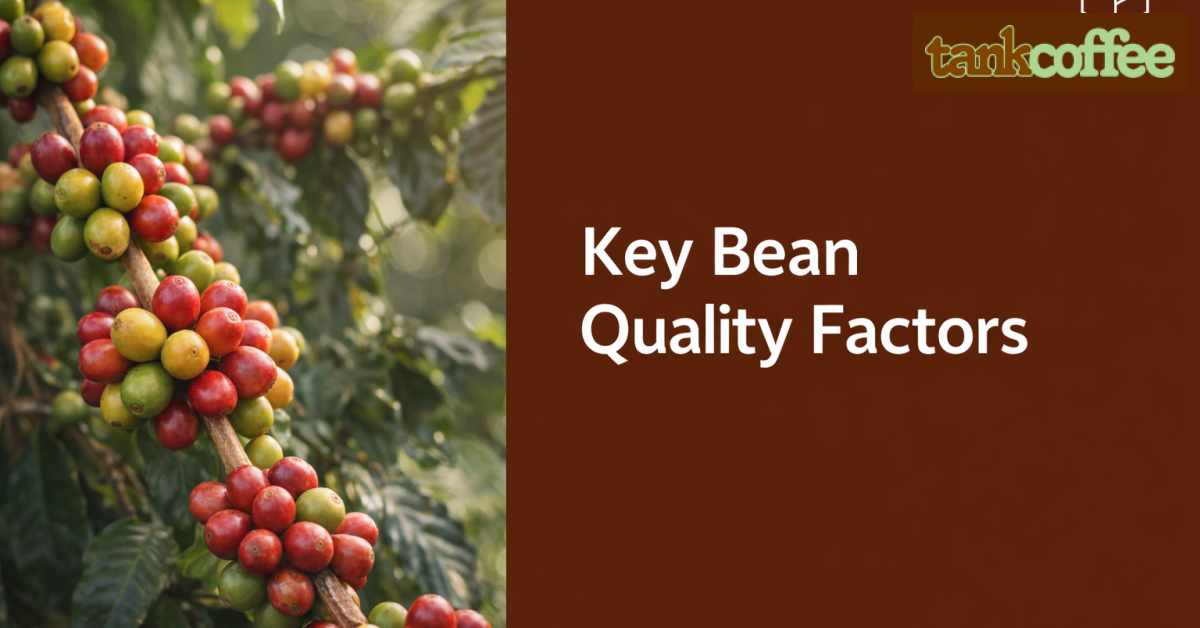
Key Bean Quality Factors
My name is Garth, and I’m the head roaster here at Tank Coffee. I spend most of my days with ‘Grace,’ our Turkish-made roaster, in our little space nestled by the Bridgewater Canal, surrounded by the old red-brick mills of Greater Manchester.
You’re standing in front of two bags of coffee, the prices are similar, and you’re worried one wrong choice means weeks of bad cups. I’ve been there. The biggest mistake is trusting the country name on the label. I’ve seen stunning Brazilian coffees and disappointing Ethiopian ones, because processing, defects, moisture, and age change the final cup far more than a flag.
I want to walk you through the exact method I use when a new sack of green beans arrives. This is the process that helps me decide if a coffee is worthy of becoming a Tank Coffee offering. It’s a combination of supplier specs, how the beans behave in a sample roast, and what the final cup tells my palate.
Origin is a Starting Point, Not a Guarantee
Bean origin tells you a story about a place, and terroir describes the local conditions. But for me, these are just chapter titles. The real details are in the fine print of region, altitude, and processing. “Colombia” is too broad. Is it from Huila or Nariño? What altitude?
Higher elevations, like where we source our Kenya Kiri Kirinyaga AB, force the bean to mature slowly. This slower growth concentrates the sugars and acids, giving you that complex, vibrant cup profile.
Processing method has a massive impact. Washed coffees, like our Ethiopia Yirgacheffe, have the fruit pulp stripped off before drying. This is what gives them that exceptionally clean, tea-like clarity.
A natural process bean, where the fruit is left on to dry, is a different beast entirely. It results in the heavy body and jammy fruit notes you might find in some of our guest espresso beans. Understanding processing helps me anticipate the character before I even turn the roaster on.
A processing method has a massive impact.
Why I Care More About Plant Genetics Than Country Names
The specific variety of the coffee plant, its genetic code, sets the boundaries for flavour. Most people know Arabica versus Robusta. Arabica typically has the aromatic complexity and sweetness we chase for our single-origin bags. Robusta has the caffeine kick and heavy body that can work in a traditional espresso blend, but it’s not our focus.
The variety dictates the bean’s physical structure. Some, like a Pacamara, are huge and need a gentler heat application. Others, like a classic Bourbon, are dense and can handle the high energy I push through Grace at the start of a roast. The variety doesn’t guarantee quality, but it tells me what’s possible.
My First Physical Checks at the Roastery
Before any bean gets near my production roaster, I get my hands in it. Physical inspection is my first line of defense against a bad batch.
Bean Size and Density: I’m looking for consistency. If I see a mix of tiny and large beans, I know I’m headed for a split roast, where the smalls will scorch before the larges are even developed.
Density, which you can feel by weight in your hand, tells me how the bean will absorb heat. A dense, hard bean can take a lot of energy, while a softer bean from a lower altitude might race to first crack and taste baked.
Moisture: I check the supplier’s moisture reading. Green coffee should be between 10-12%. Too dry, and it will roast too fast and taste flat. Too wet, and it risks tasting mouldy or grassy, a constant battle given the high humidity here in Manchester.
Defects: I spread a sample on a tray and look for trouble. Insect damage, broken beans, and “quakers” (unripened beans that don’t brown properly) all have to be sorted out. Finding more than a few stones or twigs in a sample tells me the processing was careless, and it’s a hard pass. It’s not just about flavour loss; it’s about protecting Grace’s grinder and ensuring batch consistency.
Will it Behave? Judging a Bean’s Stability in the Roaster
Great roasting isn’t magic; it’s about control. And I can only control beans that behave predictably. Stability starts long before the coffee reaches my roastery near Trafford Park.
Aged coffee is my enemy, and freshness and roast date are the first things I verify before I trust any lot’s potential in the cup. Beans from a fresh crop hold more of their delicate aromatics and bright acidity. As coffee ages, it tastes woody and muted. I always check the harvest date.
An old lot, even from a great farm, will never produce a vibrant cup. It might be serviceable for a dark, oily roast, but that’s not what we do here. A stable, fresh green bean takes heat predictably, releases moisture evenly, and allows me to repeat a great roast profile again and again.
The Final Test: What the Cup Actually Tells Me
Cupping is where theory meets reality. All the specs and data are meaningless if the coffee doesn’t taste good. Here’s what I’m looking for:
- Aroma: Is it clean and distinct? I want to smell florals or fruit, not bagginess or ferment.
- Acidity: Good acidity is bright and juicy, like biting into a crisp apple. Bad acidity is sour and sharp. Here in Manchester, our water is famously soft, with low mineral content from the Pennines. This lets the delicate, sparkling acidity of a good washed coffee really shine through in the final brew.
- Sweetness: This signals clean processing and proper sugar development. A sweet coffee feels complete.
- Body: This is about texture and weight. Our Waterfall Espresso Special Edition, for example, is blended for a heavier, more syrupy body that holds up in milk.
- Balance & Finish: Does one attribute overpower everything else? And after I swallow, is the finish clean, or does it leave a harsh, bitter note? A hidden bitterness becomes very obvious on the second or third sip.
How a Bean’s Journey Can Ruin It Before It Reaches Me
A fantastic coffee can be ruined by poor transport and storage. Long journeys in unprotected containers expose beans to heat, moisture, and odours. I always look for suppliers who use GrainPro-style liners inside the jute sacks. These barriers are critical for protecting the coffee from the elements on its long trip to the UK. Once it’s here, storing it away from the damp Manchester air is just as crucial.
If you want to go deeper on how place shapes flavour beyond the country name, read our guide to origin and terroir in coffee before you buy.
Common Traps I See New Buyers Fall Into
The biggest mistake is being seduced by appearance or a cheap price. Glossy, large beans don’t always mean a great cup. Some of the most flavourful heirlooms from Ethiopia look small and unassuming.
Likewise, if a lot is heavily discounted, my first question is “why?” Usually, it’s because of a hidden defect, old age, or poor storage history that will only reveal itself in the roaster.
The Method I Use to Confidently Buy Green Coffee
My confidence comes from a repeatable process. I read the supplier specs, especially harvest date, moisture content, and processing details. Then I run sample roasts to see how the bean develops and if the notes on the label actually appear in the cup.
Finally, I think about the brewing method. A defect that might be hidden in a French press will be screamingly obvious in an espresso shot. This disciplined comparison is how I reduce guesswork.
My Go/No-Go Roasting Rubric
I use a mental checklist for every potential coffee. It needs strong signals across the board, not just one impressive feature.
A simple rubric helps new buyers turn scattered quality signals into a clear buying decision. The strongest lots usually score well across consistency, freshness, cup quality, and storage history rather than relying on one impressive attribute.
| Factor | Strong Signal | Warning Sign | Why It Matters |
|---|---|---|---|
| Origin And Processing | Clear region, variety, process, and harvest details | Vague or missing lot information | Traceability improves prediction of flavour and quality |
| Physical Quality | Even screen size, stable moisture, low visible defects | Mixed size, chipped beans, foreign matter | Uniform coffee roasts more evenly and creates less waste |
| Roast Behaviour | Predictable development and even colour in sample roast | Fast tipping, uneven colour, unstable batches | Roast control depends on green bean consistency |
| Cup Quality | Clean aroma, clear sweetness, balanced finish | Flat, sour, harsh, or dirty notes | Final flavour confirms whether the lot is worth buying |
| Storage And Age | Fresh crop and protected packaging | Old stock, weak packaging, unclear storage history | Age and exposure reduce flavour and stability |
The rubric works best when each factor supports the others rather than compensating for a weak lot.
From My Roastery to Your Cup
Ultimately, the key factors that define a quality bean go far beyond the country name. The origin, variety, physical condition, and roast stability all have to line up.
When the supplier data is transparent, my sample roasts are clean, and the final cup is balanced, I know I’ve found a coffee worth sharing. That’s the only time a bean gets the Tank Coffee name.
If you want a quick refresher on the fundamentals before applying this quality checklist, start with coffee beans basics to ground the terms and expectations.