

How Hard to Tamp Espresso
Espresso tamping rewards firm, level pressure far more than brute force. Once the coffee bed is fully compressed, extra weight behind the tamper changes very little about extraction. What moves shot quality is the combination of grind size, dose, distribution, and a tamp that lands the same way every time. A working reference of roughly 10 to 15 kg of downward force suits most home and commercial setups, with the grinder, not your arm, handling the fine adjustments.
Key Takeaways
Here is a quick summary of what firm, repeatable tamping actually achieves at the espresso machine.
- Aim for roughly 10 to 15 kg of downward force, enough to fully compress the puck without straining.
- Level and repeatability matter more than absolute pressure.
- Grind size, not tamp force, controls shot time.
- Distribution problems cannot be fixed by tamping harder.
- Match tamper size to basket, typically 58.5 mm for a 58 mm basket.
- Pressurised baskets are more forgiving; non-pressurised baskets expose every prep flaw.
Treat tamping as the stable middle step between distribution and extraction, and most variability disappears.
What Tamping Pressure Really Controls
Tamping compacts loose grounds into a stable puck that resists brewing pressure evenly across the basket. The compression removes air pockets and locks fines into place so water meets similar density from edge to centre. Past full compaction, pushing harder mostly tires the wrist. It helps to remember how espresso differs from other black coffee styles here, because pressure-driven extraction is what makes the puck itself the defining variable.
The practical test is flow behaviour, not feel. If a repeated dose, grind, and yield produce shot times within a second or two of each other, tamping is doing its job. If times drift while everything else stays fixed, the tamp is usually where the variance hides.
Pressure vs Consistency
Small changes in force matter far less than small changes in levelness. A 12 kg tamp that lands perfectly flat extracts more cleanly than a 20 kg tamp with a 3 degree tilt. That tilt creates one edge with lower resistance, and pressurised water finds it within seconds of the pump starting.
Why Recipes Talk About Distribution First
Distribution decides how evenly water can travel before tamping has even begun. A mound on one side of the basket leaves that area denser after compression, regardless of how hard the tamper comes down. WDT tools, light taps, and levelling rings exist because tamping cannot undo an uneven starting bed.
The point is straightforward: prep evenly before the tamper touches the coffee.
The 10 to 15 kg Working Range
The 10 to 15 kg reference comes from training environments and calibrated tampers, where baristas can feel what reliable compression is. Within that band, most 58 mm baskets reach full puck density without athletic pressing. Some setups work happily at 8 kg, some closer to 20, and the difference rarely shows in the cup once grind and dose are dialled.
Force at the high end brings two hidden costs. The first is fatigue across a busy service, which quietly breeds inconsistency. The second is a tamping motion that becomes harder to keep perpendicular to the basket, because heavier presses drag the wrist out of alignment.
When Extra Force Stops Helping
There is a point, usually reached around the lower end of that range, where puck density stops changing in any meaningful way. Beyond that, you are compressing what is already compressed. Flow resistance from that moment onward is controlled by particle size, not by how much you lean into the tamper.
Hard Enough as a Working Concept
Hard enough means the tamper stops descending because the bed has given everything it can give. There is a small but recognisable moment where the puck settles and further pressure produces no movement. Learning to feel that point is more useful than memorising a number on a bathroom scale.
How Grind Size Changes the Role of Tamping
Grind size is the lever that actually changes shot time. A finer grind builds resistance across the whole puck, slows flow, and lengthens extraction. A coarser grind does the opposite, and no amount of tamping force closes that gap. Reaching for a harder press to rescue a fast shot is one of the most common early-stage mistakes at the machine.
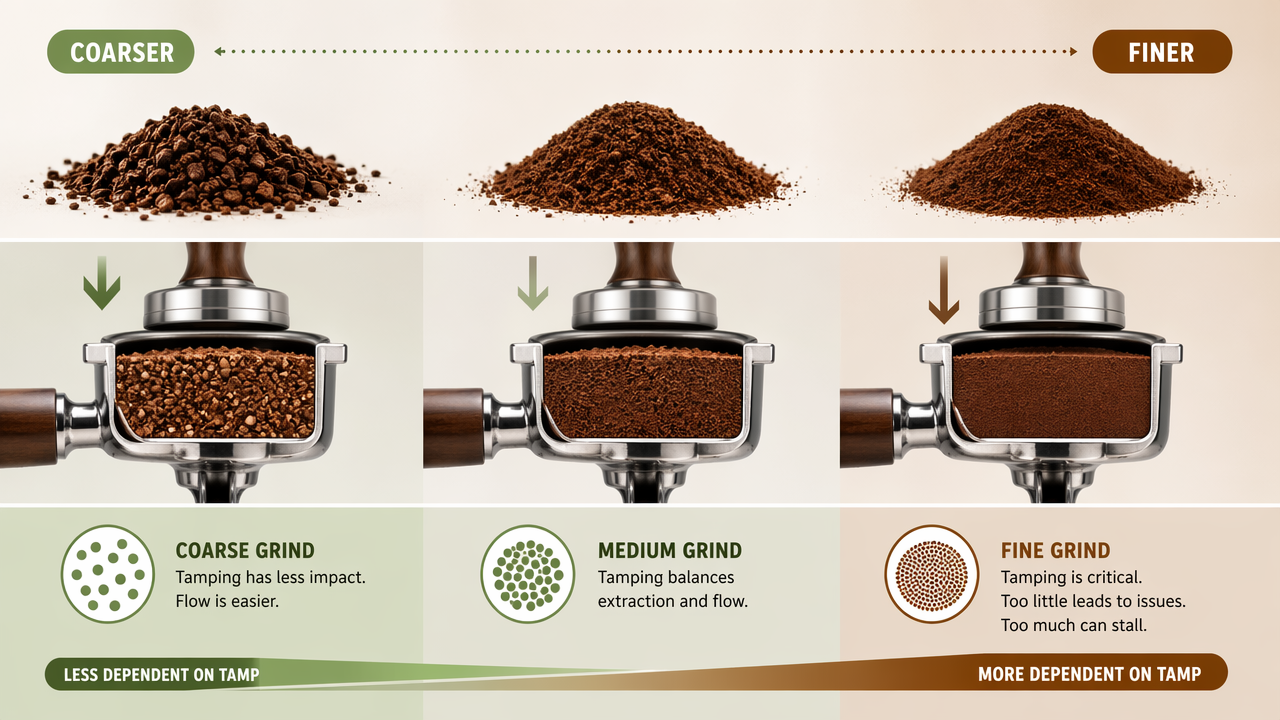
The cleaner workflow is simple: fix prep, then adjust the grinder. If distribution is level and the tamp is straight, grind becomes the only variable worth touching.
Fine Grinds: Consistency Over Force
Fine grinds already generate high resistance, so adding force to the tamp buys almost nothing. What tends to suffer with fine grinds is distribution, because fine particles clump and form micro-voids. A gentle stir or WDT pass usually helps more than pressing harder.
Coarse Grinds Expose Weak Prep
Coarse grinds run fast and thin, so any unevenness becomes visible in seconds. A tilted puck or clumped bed shows up immediately as spraying, splitting, or blonding on one side of the stream. Coarse settings are an honest diagnostic for tamping technique.
How to Tamp Correctly
The motion that repeats best is boring to watch, and that is the point. Portafilter on a stable tamping mat, tamper perpendicular to the basket, one steady press down, controlled release. No shimmy, no polish, no finishing twist that drags fines outward.
Wrist and elbow alignment do the real work. Tamping from the shoulder with a locked wrist keeps the tamper level far more reliably than tamping from the forearm.
Level the Bed First
Check for a flat starting surface before the tamper touches anything. A slight mound on one side will survive compression and become a density gradient during the shot. Distribution tools help, but a simple side-to-side visual check catches most issues.
Press Straight, Release Clean
A straight press treats the puck as a single unit. Releasing cleanly, without rocking the tamper, avoids pulling fines toward the basket wall. That edge disturbance is a common source of side channelling that looks like a tamping pressure problem but is really a release problem.
Reading the Signs of a Tamping Fault
Tamping errors rarely announce themselves directly. They appear through shot speed, puck shape, stream behaviour, and taste, all of which overlap with grind and distribution problems. Isolating the cause means holding dose and yield fixed and changing one thing at a time.
| Sign | Likely Tamping Issue | Better First Check |
|---|---|---|
| Shot runs very fast | Loose or uneven puck | Finer grind, improve distribution |
| Shot stalls or crawls | Over-compensating with force | Coarser grind before reducing tamp |
| Puck slopes after brewing | Tamp not level | Body position, basket support |
| Stream sprays or splits | Channelling from uneven density | Distribution, straight press |
| Sour and bitter together | Partial channelling | Full prep review |
Use the table as a starting point rather than a diagnosis, and let controlled changes confirm the real cause.
Fast Shots and Loose Pucks
Fast shots often trace back to a puck that never reached full compression, usually because of a rushed tamp or an undersized tamper that left the bed loose near the wall. If distribution is fine and the tamp looks level, grind is the next adjustment.
Slow Shots and the Force Trap
Slow shots tempt baristas to ease off the tamp, but the real fix is almost always a coarser grind. Softening the tamp creates a different problem rather than solving the original one, and the next shot will behave unpredictably.
Crooked Pucks
A puck that comes out of the basket with a visible slope points to uneven tamping pressure, often from pressing while the portafilter rests on a counter edge rather than a flat mat. Side channelling follows quickly, because one edge of the puck offers less resistance.
Common Tamping Mistakes
Most tamping problems are setup problems in disguise. The surface, the basket fit, the body position, and the prep routine all shape the final puck before pressure is applied.
Twisting at the End
The polish twist was once taught as standard. It disturbs fines at the surface and drags them toward the edges, which is exactly where you do not want a lower-density ring forming. A flat finish holds up better.
Unstable Tamping Surface
Tamping on the counter edge, on a drip tray, or on any surface that flexes introduces tilt. A dedicated tamping mat on a solid surface is the cheapest consistency upgrade in a home setup.
Using Force to Fix Distribution
Clumps, voids, and mounds stay inside the puck no matter how hard the tamper comes down. The problem only reveals itself during extraction, by which point it is too late.
Changing Pressure Between Shots
Varying pressure from shot to shot adds noise that turns grinder adjustments into guesswork. Pick a level, repeat it, and let the grinder do the fine-tuning.
Keeping Tamping Consistent
Consistency comes from posture and routine more than from measurement. A calibrated tamper is useful for training the feel of a specific force, but few working baristas check the dial once the motion is learned.
Same Body Position Each Time
Stand square to the machine, shoulder over the portafilter, elbow tracking vertically, wrist locked. Small variations in stance produce small variations in tamp angle, and those produce visible variations in shot behaviour.
Match Tamper to Basket
A 58 mm basket needs a tamper close to 58 mm, usually 58.5. Undersized tampers leave a ring of loose grounds around the wall, which is where water will escape first. This is one of the most common oversights in home setups using generic tampers.
A Repeatable Prep Order
Dose, distribute, tamp, lock in. Same order, same timing, same movements. Drift creeps in the moment the order changes under pressure.
Does Tamper Type Change How Hard to Tamp
Tamper design changes feel, not fundamentals. Full compression and a level finish remain the goal regardless of base shape or handle style.
Flat vs Convex Bases
Flat bases suit the majority of modern precision baskets. Convex designs shape the puck slightly and can help in edge-channelling situations, but the gains are setup-specific and easy to overstate.
Calibrated Tampers
Calibrated tampers click at a preset force, typically around 13 to 15 kg. They are useful for training the feel of consistent pressure, particularly in a multi-barista environment where tamping style varies.
Palm Tampers
Palm tampers control depth by bottoming out on the basket rim, so tamping depth becomes the constant rather than force. They work best when dose is tightly controlled, because headspace variation changes how the tamper engages.
Setup Differences That Matter
Espresso equipment affects how sensitive the puck is to tamping at all. A home machine with a pressurised basket behaves very differently from a commercial grouphead with a precision non-pressurised basket.
Pressurised Baskets
Pressurised baskets create artificial back-pressure through a restricted outlet, which masks a lot of prep variation. Tamping still needs to be level, but the exact force is less critical.
Non-Pressurised Baskets
Non-pressurised baskets let the puck do the work, so every prep error shows up. This is where the 10 to 15 kg range earns its reputation and where distribution technique pays back most visibly.
Roast Level and Dose
Lighter roasts are denser and typically need finer grinding, which raises resistance and exposes tamping flaws more clearly. Darker roasts, including the Ethiopian origins and African-forward blends UK roasters favour, extract more readily and tolerate small prep variations better.
Dose changes headspace, and headspace changes how the tamper meets the bed, which is why moving from 18 g to 20 g in the same basket can shift the feel of a normal tamp.
The Short Answer
Tamp firmly, tamp level, tamp the same way every time. Somewhere around 10 to 15 kg is enough for almost any espresso setup, and past full compression the extra effort is wasted.
Control shot time with the grinder, control evenness with distribution, and let tamping be the stable, repeatable step in the middle.
Putting It Into Practice
If you are working through a new bag of beans, start with a level prep, a firm consistent tamp, and adjust grind only. Keep dose and yield fixed for a day or two until the coffee settles. The shots that follow will tell you more about your routine than any single tamp pressure ever could.
Fresh beans respond to this approach faster than older stock, which is one practical reason roast date matters when dialling in a new espresso. Working with recently roasted coffee from a small-batch roaster, including UK suppliers shipping origin-led beans from roasters in Greater Manchester, shortens the dial-in window and keeps flavours distinct enough to evaluate prep changes honestly.
Frequently Asked Questions
Is 30 lb tamping pressure really necessary for good espresso?
No. The 30 lb figure, roughly 13.6 kg, became a training shorthand but was never a scientific requirement. Any firm tamp that reaches full puck compression, typically 10 to 15 kg, produces the same extraction result as long as it is level and repeatable.
Can I fix a fast-running shot by tamping harder?
Not reliably. Once the puck is fully compressed, extra force stops changing density, so the shot still runs fast. The fix is a finer grind, with a check on distribution first to rule out channelling as the actual cause.
Does tamping pressure matter less with a pressurised basket?
Yes, noticeably. Pressurised baskets create back-pressure through a restricted outlet rather than through the coffee puck, so tamp force has a smaller effect on flow. Keeping the tamp level still matters, but precision on pressure is less important than on a non-pressurised basket.